Lately, a number of stories shared in these pages have touched on the memories that resurface later in life — the childhood wounds, neglect, and betrayals that shape us long after we’ve learnt to smile through them.
I’m reading Nobody’s Girl by Virginia Giuffre, and I’m not even up to the Epstein chapters yet. She is only 15 where I am up to, and already I’m wrecked.
Because before the private jets, the billionaires, the headlines, there was a little girl being abused in her own home.
A father who took what was never his to take.
A mother who, for reasons we’ll never fully know, looked the other way.
A family who heard the screams and did nothing.
We’ve spent years focusing on the Epsteins, the Maxwells, the Prince Andrews. We’ve turned the abuse of young women into clickbait, into courtroom theatre. But before there were global headlines, there were homes — homes where the first betrayals happened, where girls learnt that speaking the truth would cost them love, stability, or safety.
And I can’t stop thinking: Where were the women?
The silence that starts at home
We like to believe that women — mothers especially — are wired to protect. That somewhere deep inside us there’s a primal code that says no one touches my child.
And yet, time after time, we see women who do know, or at least sense, and still stay quiet. They convince themselves it’s not happening. They hope it will stop. They don’t want to believe the man they chose could be capable of it. They fear losing their home, their reputation, their sense of control.
Maybe it’s conditioning. Maybe it’s terror. Maybe it’s centuries of messages telling us to keep the peace, keep the man, keep the life together.
It’s the same paradigm that allows domestic violence to keep rising — an undercurrent of fear and acceptance that teaches women to endure, to excuse, to stay quiet. But whatever it is, it’s costing our daughters their innocence, their safety, and their belief that women are safe to turn to.
I’ve seen it and lived it, across generations
I don’t write this from the sidelines. In my own family, including my own personal experience, there were blurred boundaries that were never questioned — and later, stories that surfaced which were not blurred at all. They were textbook sexual abuse.
I also personally know women who have lived these stories. Women who now say, “How did my mother not know?” Women who finally found the courage to tell the truth, only to be met with, “No, that didn’t happen,” or “No one can ever know — it’ll ruin the family.”
And it isn’t always family. Sometimes it’s teachers, coaches, neighbours, mentors. People trusted and known. People protected by silence.
When these things aren’t confronted in the moment, time distorts them. Memory softens the edges, shame reshapes the details, and the story changes as protection takes hold. Decades later, when survivors finally speak, they’re no longer the children who lived it. They’re adults carrying guilt, confusion, and the fear that no one will believe them. They question themselves before anyone else does.
And that’s the cruellest part. Not only were they unprotected then — but now the truth itself is questioned. This is what silence creates: not just pain, but complexity.
Healing becomes harder, not because the wound is gone, but because its outline has blurred.
The power that protects men
We have to name it. There’s a power that still sits with men, even in the homes and hearts of strong women. It’s the power of approval, of belonging, of perceived safety.
It’s the power that says: If I stand against him, I’ll lose everything.
It’s the lie that’s been passed down for generations — that our worth is tied to keeping the peace, not breaking the silence.
But every time we protect a man’s comfort over a child’s safety, we abandon the next generation of girls to the same cycle.
The women who knew — and the ones who will no longer look away
In Virginia’s story, there were women at every turn, and the first was her mother. Giuffre writes that her mother knew. Her mother denies it, but Virginia remembers differently. Her wider family knew, because she screamed it out loud at a family gathering and no one did anything.
The institutions knew. She recounts being encouraged to journal about the sexual abuse she and other girls were experiencing while in state care. And still, no one intervened.
This isn’t isolated. Look at the high-profile orbit, because this doesn’t happen only in quiet homes.
Ghislaine Maxwell wasn’t a bystander; she was convicted of recruiting and grooming girls for Epstein — befriending them, coaching them, and normalising access. Her legal team later cited an emotionally abusive upbringing under her father to explain her compliance. It’s not an excuse, but it shows how cycles of harm can warp loyalty and silence truth.
Sarah Ferguson publicly apologised for accepting money from Epstein and later wrote to him calling him a “supreme friend,” even as she distanced herself in public. Her life story shows the undercurrent many women live beneath: a childhood shaped by family fracture and emotional absence, followed by adult years overshadowed by financial strain and dependency.
For a woman raised inside privilege, the fear of losing status, reputation, or belonging can be as powerful as the fear of physical survival. It doesn’t excuse the choice to stay close to power — but it helps us see how fear of loss and conditioning towards loyalty keep so many women silent.
Harvey Weinstein’s empire survived for decades because people around him enabled or ignored what was happening. It wasn’t only men protecting him. Women inside that system stayed silent too, many bound by non-disclosure agreements that acted as legalised coercive control.
Former assistant Zelda Perkins broke her silence years later, describing how Miramax forced her to sign an NDA that prevented her from warning others. Lauren O’Connor, another employee, wrote an internal memo detailing Weinstein’s abuse that was buried instead of acted upon. Even powerful Hollywood women like Amy Pascal and Donna Langley have since admitted they heard the rumours but felt powerless to confront him, while actresses Rosanna Arquette and Mira Sorvino spoke of being ostracised after rejecting him.
This is what fear and conditioning look like when dressed in professionalism and success — the hierarchy that teaches women to protect the power that harms them.
Then there’s France’s Pelicot case. Dominique Pelicot drugged his wife, Gisèle, and invited dozens of men to rape her over nearly a decade. Their daughter, Caroline Darian, says she tried to warn her mother — not only that her father had abused her, but that he was continuing to abuse Gisèle as well.
Still, Gisèle refused to believe her.
Caroline later described the moment her mother withdrew her hand in court as she recounted her abuse: “My mother let go of my hand in that courtroom… She abandoned me.”
That moment captured everything — the collapse of maternal protection, the denial of truth, and the generational fracture that follows when a woman cannot bear to face what she has lived beside.
And now — another woman looks away, publicly
As this article goes live, another woman — and a mother — has stepped into the spotlight with the same pattern of minimisation.
On her SiriusXM show, Megyn Kelly defended distinctions about Epstein’s victims that immediately sparked global outrage. She said Jeffrey Epstein “was into the barely legal type,” and that “he liked 15-year-old girls,” implying this somehow made him “not a paedophile.” She even added, “He wasn’t into, like, eight-year-olds.”
The reaction was immediate: horror, disbelief, and a collective exhale from survivors who know what statements like this do. They minimise, excuse, and blur the line of harm. They teach girls once again that their suffering is negotiable — dependent on age, not violation.
And once again, the question echoes: Why is it women who are doing this?
These aren’t outliers. They reveal the thread running through all of it: women’s silence — whether born of fear, conditioning, dependence, or misplaced loyalty — magnifies the harm.
The reckoning
If you are a woman who knows, speak.
If you are a mother who senses, act.
If you are a friend who suspects, intervene.
And if you are one of these women — the one feeling fear, guilt, denial, or shame tightening in the pit of your stomach right now — ask yourself why.
Why are you refusing to look at your own wound?
Why are you protecting what broke you instead of healing it?
Why are you allowing the same silence that harmed you to endanger another child?
This is how it continues, generation after generation.
Not just through the men who abuse, but through the women who cannot bear to face what was done to them, or by them, or in front of them.
The first act of courage isn’t calling the authorities — it’s calling yourself into accountability.
The next act is making sure no girl in your orbit ever learns to swallow her voice the way you once did.
We can’t keep saying, It’s not my place.
It is. It always was.
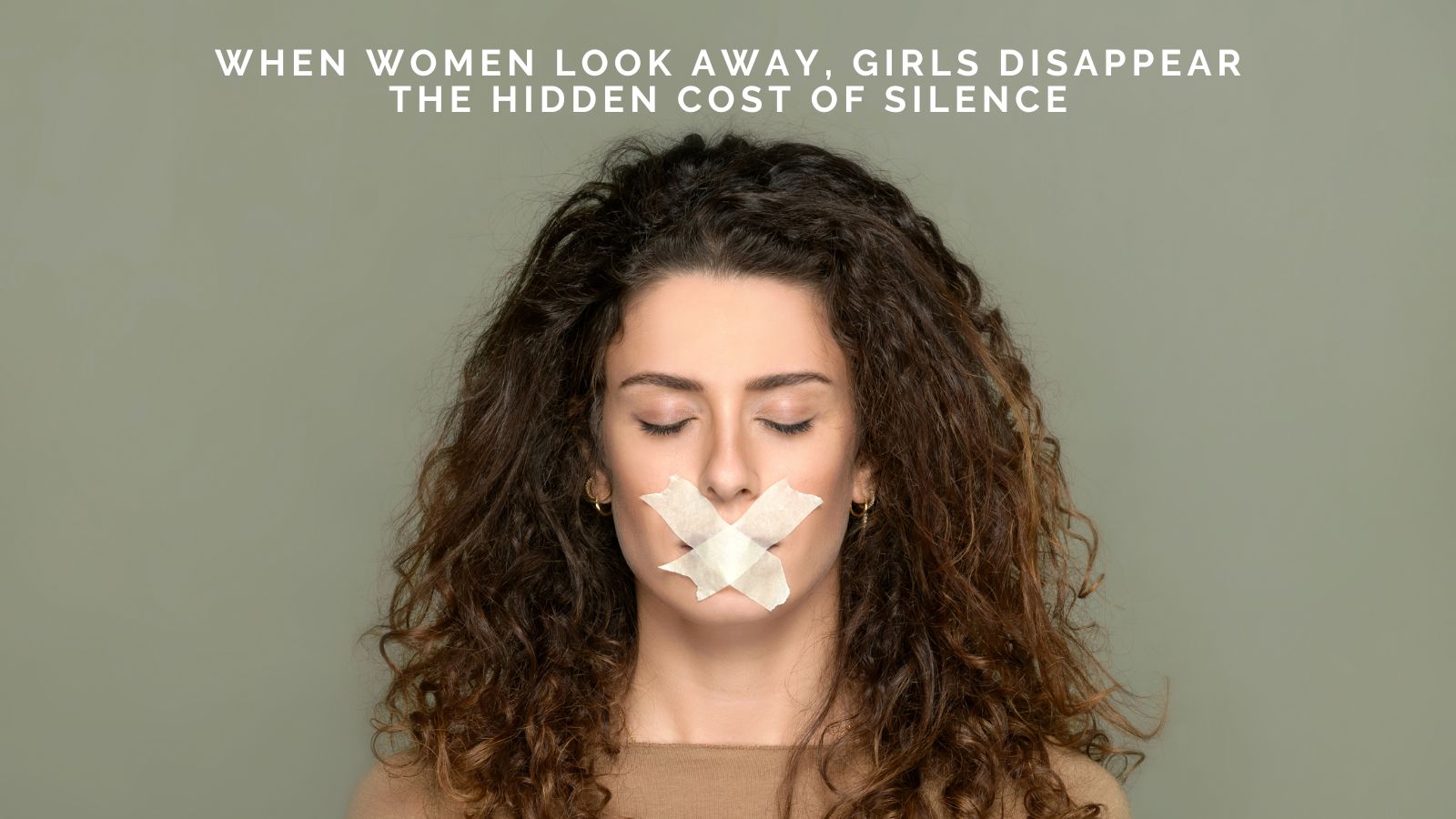
Because when women look away, girls disappear.


 (10).png)